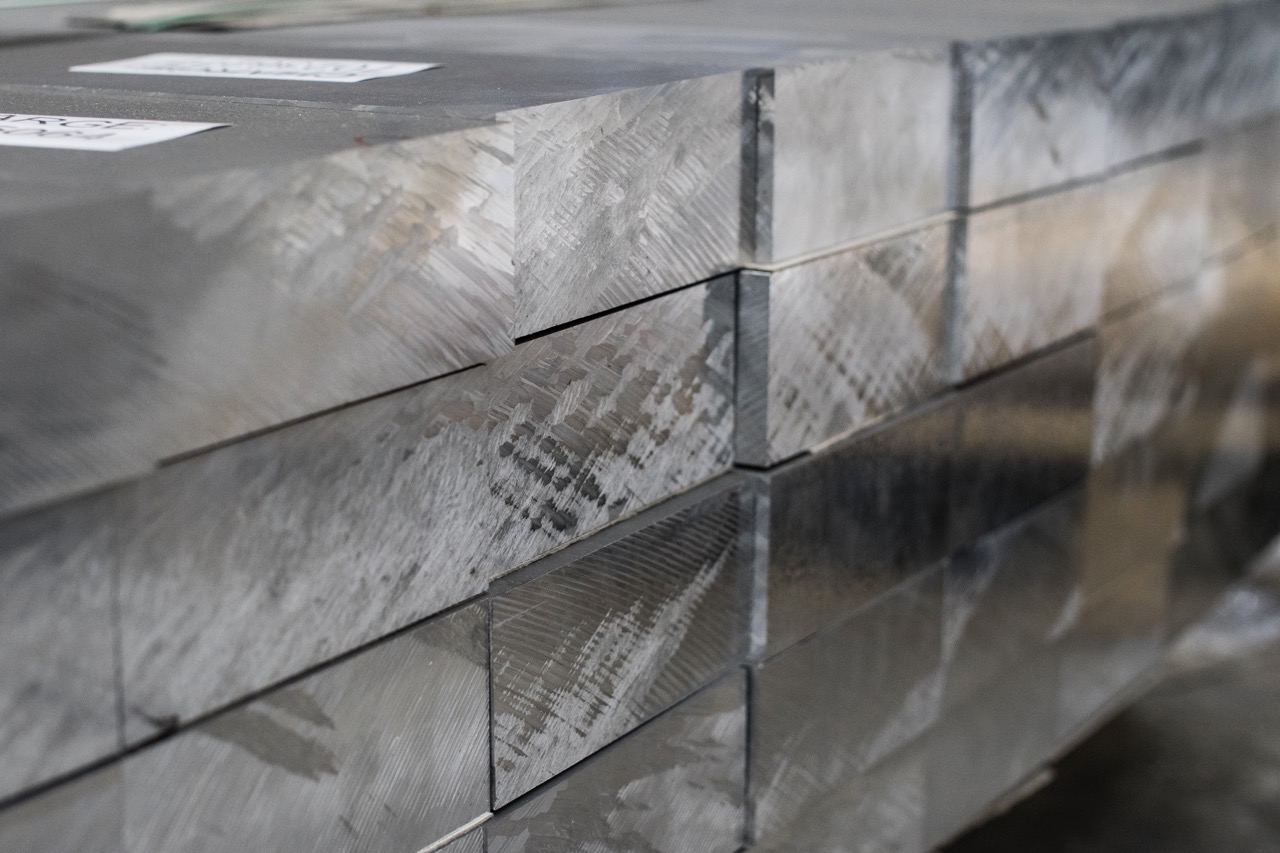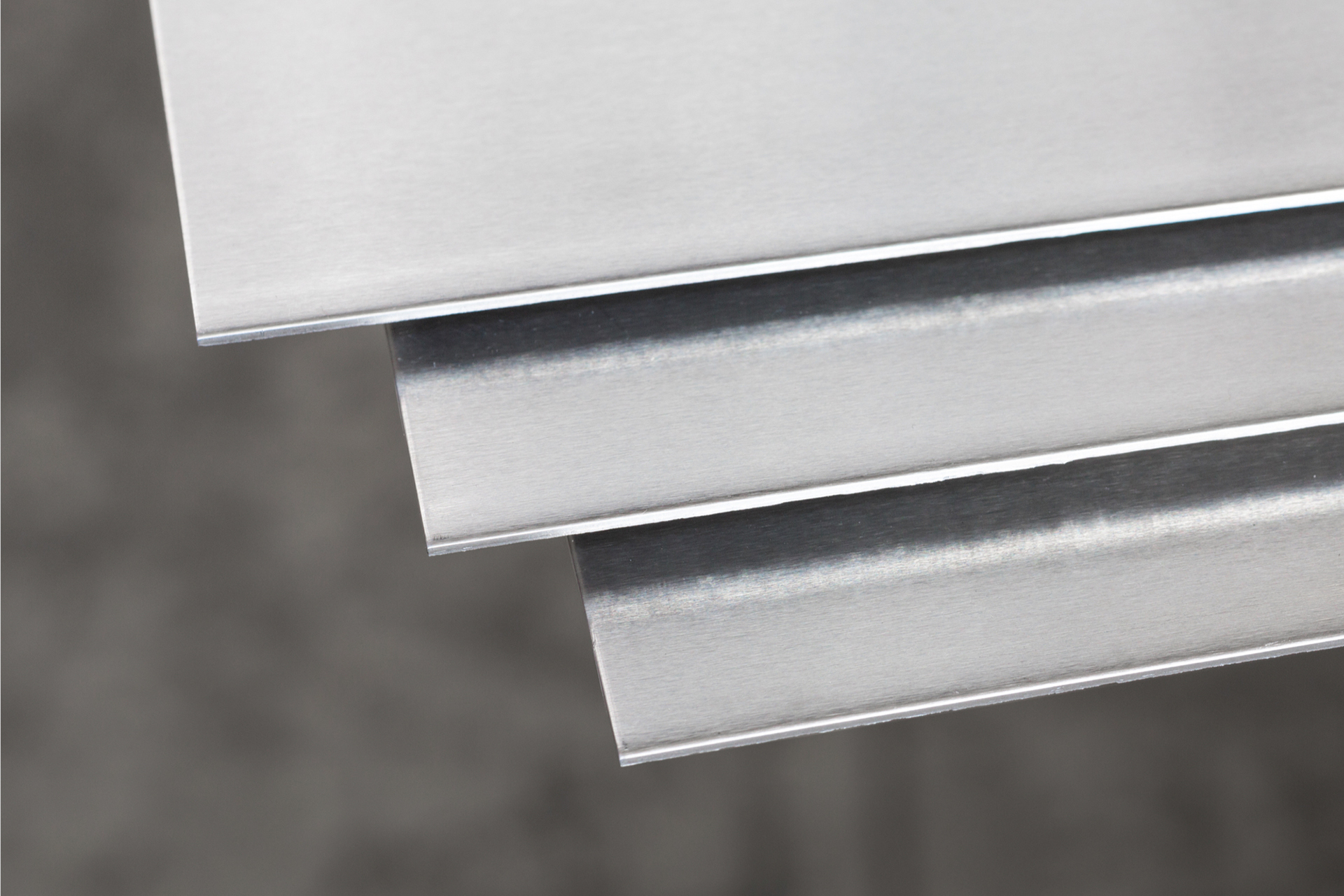
A widely usable alloy grade, characterised by medium or slightly higher strength. It machines and welds well – an alloy used especially on the American market!
(EN 573-3)
| Specifications (%) Remainder: Aluminium |
Others | ||||||||||||
|---|---|---|---|---|---|---|---|---|---|---|---|---|---|
| Si | Fe | Cu | Mn | Mg | Cr | Ni | Zn | Ti | Ga | V | Notes | Each | Total2 |
| 0,40 - 0,80 | 0,70 | 0,15 - 0,40 | 0,15 | 0,80 - 1,20 | 0,04 - 0,35 | - | 0,25 | 0,15 | - | - | - | 0,05 | 0,15 |
DIN EN 485-2:2009-01
EN 485-2:2008
| Temper | Nominal thickness t [mm] |
Tensile strength Rm min. [MPa] |
Proof strength Rp0,2 min. [MPa] |
Elongation A50 or A min. [%] |
Bend factor 90° rmin [·t] |
Hardness HBW |
|---|---|---|---|---|---|---|
| T6 | ≥ 0,4 – 1,5 | 290 | 240 | 6 | 2,5 · tb | 88 |
| 1,5 – 3,0 | 290 | 240 | 7 | 3,5 · tb | 88 | |
| 3,0 – 6,0 | 290 | 240 | 9 | 4,0 · tb | 88 | |
| 6,0 – 12,5 | 290 | 240 | 10 | 5,0 · tb | 88 | |
| 12,5 – 40,0 | 290 | 240 | 8 | — | 88 | |
| 40,0 – 80,0 | 290 | 240 | 6 | — | 88 | |
| 80,0 – 100,0 | 275 | 240 | 5 | — | 84 | |
| 100,0 – 150,0 | 275 | 230 | 4 | — | 81 | |
| 150,0 – 250,0 | 265 | 230 | 4 | — | 81 | |
| 250,0 – 350,0 | 260 | 220 | 3 | — | 80 | |
| 350,0 – 400,0 | 260 | 220 | 2 | — | 80 | |
| T651 | ≥ 0,4 – 1,5 | 290 | 240 | 6 | 2,5 · tb | 88 |
| 1,5 – 3,0 | 290 | 240 | 7 | 3,5 · tb | 88 | |
| 3,0 – 6,0 | 290 | 240 | 9 | 4,0 · tb | 88 | |
| 6,0 – 12,5 | 290 | 240 | 10 | 5,0 · tb | 88 | |
| 12,5 – 40,0 | 290 | 240 | 8 | — | 88 | |
| 40,0 – 80,0 | 290 | 240 | 6 | — | 88 | |
| 80,0 – 100,0 | 275 | 240 | 5 | — | 84 | |
| 100,0 – 150,0 | 275 | 230 | 4 | — | 81 | |
| 150,0 – 250,0 | 265 | 230 | 4 | — | 81 | |
| 250,0 – 350,0 | 260 | 220 | 3 | — | 80 | |
| 350,0 – 400,0 | 260 | 220 | 2 | — | 80 |
Notes:
• The table contains processed, condensed data from EN 485-2.
• Bend radius values are indicative (rmin ≈ k·t).
• HBW: Brinell hardness, carbide-ball test.
• Ahol A50 is not given, the general elongation value “A” is stated in the standard.
The values and data below are indicative – they help to give a general picture of the material.
| EN AW | Al Mg1 Si Cu |
|---|---|
| Old designation | Al Mg1 Si Cu |
| Material number (DIN) | 3.3211 |
| United Kingdom (BS) | H20 |
| Italy (UNI) | 9006/2 |
| Spain | L-3420 |
| Sweden | - |
| Norway | - |
| France (AFNOR) | A-GSUC |
| Colour code | - |
| Density [g/cm3] | 2,70 |
|---|---|
| Modulus of elasticity [GPa] | 70,0 |
| Thermal conductivity [W/m*K] | 170 – 200 |
| Thermal expansion coefficient [K-1*10-6] | -50°C – 20°C |
| 20°C – 100°C | 23,0 | |
| 20°C – 200°C | |
| 20°C – 300°C | |
| Specific heat [J/(kg*K)] | - |
| Electrical conductivity [m/Ω*mm2] | 22 – 30 |
| Shear modulus [GPa] | 26,3 |
| Annealing / recrystallisation annealing | |
|---|---|
| Annealing temperature | 380°C – 420°C |
| Heat-up time | 1 – 2 hours |
| Cooling conditions | 30°C/hour to 250°C, air below 250°C |
| Hardening | |
|---|---|
| Solution heat treatment | 525°C – 540°C |
| Quenching | water |
| Natural ageing | 5 – 8 days |
| Artificial ageing | 155°C – 190°C · 4 – 16 hours |
| Machinability | |
|---|---|
| Annealed | 4 |
| Work-hardened | - |
| Heat-treated | 2 |
| Dimensional stability | - |
| EDM | 1 |
| Surface treatment | |
|---|---|
| Anodising – (protective) | 1 |
| Special anodising quality (EQ) | - |
| Anodising – decorative | 3 |
| Painting / coating | 2 |
| Polishing | 1 – 2 |
| Weldability | ||
|---|---|---|
| Process | Value | Filler metal |
| Gas | 3 | |
| TIG | 2 | SG-Al Mg4 |
| MIG | 1 | SG-Al Mg4,5 Mn / SG-Al Si5 |
| Resistance welding | 3 | |
| Solderability | |
|---|---|
| Brazing with flux | 3 – 5 |
| Brazing without flux | 4 |
| Abrasion soldering | 2 |
| Soft soldering with flux | 3 |
| Corrosion resistance | |
|---|---|
| Normal atmosphere | 2 |
| Marine environment | 2 – 3 |
| Formability | ||
|---|---|---|
| Cold forming | Value | Delivery temper |
| Bending | 3 | T3 · T4 |
| Compression forming | 2 | O |
| Deep drawing | 2 | O |
| Upsetting | 2 | O |
| Impact extrusion | 2 | O |
| Hot forming | ||
|---|---|---|
| Closed-die forging | 2 | |
| Extrusion | 2 | |
| Hammer forging | 2 | |
| Food-contact use (DIN EN 602) | yes |
|---|
EN 485-3:2003
|
Nominal thickness t [mm] |
Thickness tolerances by nominal plate width [mm] |
||||
|---|---|---|---|---|---|
| ≤ 1 250 | > 1 250 – 1 600 | > 1 600 – 2 000 | > 2 000 – 2 500 | > 2 500 – 3 500 | |
| ≥ 2,5 – 4 | ± 0,28 | ± 0,28 | ± 0,32 | ± 0,35 | ± 0,40 |
| 4 – 5 | ± 0,30 | ± 0,30 | ± 0,35 | ± 0,40 | ± 0,45 |
| 5 – 6 | ± 0,32 | ± 0,32 | ± 0,40 | ± 0,45 | ± 0,50 |
| 6 – 8 | ± 0,35 | ± 0,40 | ± 0,40 | ± 0,50 | ± 0,55 |
| 8 – 10 | ± 0,45 | ± 0,50 | ± 0,50 | ± 0,55 | ± 0,60 |
| 10 – 15 | ± 0,50 | ± 0,60 | ± 0,65 | ± 0,65 | ± 0,80 |
| 15 – 20 | ± 0,60 | ± 0,70 | ± 0,75 | ± 0,80 | ± 0,90 |
| 20 – 30 | ± 0,65 | ± 0,75 | ± 0,85 | ± 0,90 | ± 1,0 |
| 30 – 40 | ± 0,75 | ± 0,85 | ± 1,0 | ± 1,1 | ± 1,2 |
| 40 – 50 | ± 0,90 | ± 1,0 | ± 1,1 | ± 1,2 | ± 1,5 |
| 50 – 60 | ± 1,1 | ± 1,2 | ± 1,4 | ± 1,5 | ± 1,7 |
| 60 – 80 | ± 1,4 | ± 1,5 | ± 1,7 | ± 1,9 | ± 2,0 |
| 80 – 100 | ± 1,7 | ± 1,8 | ± 1,9 | ± 2,1 | ± 2,2 |
| 100 – 150 | ± 2,1 | ± 2,2 | ± 2,5 | ± 2,6 | — |
| 150 – 220 | ± 2,5 | ± 2,6 | ± 2,9 | ± 3,0 | — |
| 220 – 350 | ± 2,8 | ± 2,9 | ± 3,2 | ± 3,3 | — |
| 350 – 400 | ± 3,5 | ± 3,7 | ± 3,9 | ± 4,2 | — |
EN 485-3:2003
|
Nominal thickness t [mm] |
Thickness tolerances by nominal plate width [mm] |
||||
|---|---|---|---|---|---|
| ≤ 1 250 | > 1 250 – 1 600 | > 1 600 – 2 000 | > 2 000 – 2 500 | > 2 500 – 3 500 | |
| ≥ 2,5 – 4 | ± 0,28 | ± 0,28 | ± 0,32 | ± 0,35 | ± 0,40 |
| 4 – 5 | ± 0,30 | ± 0,30 | ± 0,35 | ± 0,40 | ± 0,45 |
| 5 – 6 | ± 0,32 | ± 0,32 | ± 0,40 | ± 0,45 | ± 0,50 |
| 6 – 8 | ± 0,35 | ± 0,40 | ± 0,40 | ± 0,50 | ± 0,55 |
| 8 – 10 | ± 0,45 | ± 0,50 | ± 0,50 | ± 0,55 | ± 0,60 |
| 10 – 15 | ± 0,50 | ± 0,60 | ± 0,65 | ± 0,65 | ± 0,80 |
| 15 – 20 | ± 0,60 | ± 0,70 | ± 0,75 | ± 0,80 | ± 0,90 |
| 20 – 30 | ± 0,65 | ± 0,75 | ± 0,85 | ± 0,90 | ± 1,0 |
| 30 – 40 | ± 0,75 | ± 0,85 | ± 1,0 | ± 1,1 | ± 1,2 |
| 40 – 50 | ± 0,90 | ± 1,0 | ± 1,1 | ± 1,2 | ± 1,5 |
| 50 – 60 | ± 1,1 | ± 1,2 | ± 1,4 | ± 1,5 | ± 1,7 |
| 60 – 80 | ± 1,4 | ± 1,5 | ± 1,7 | ± 1,9 | ± 2,0 |
| 80 – 100 | ± 1,7 | ± 1,8 | ± 1,9 | ± 2,1 | ± 2,2 |
| 100 – 150 | ± 2,1 | ± 2,2 | ± 2,5 | ± 2,6 | — |
| 150 – 220 | ± 2,5 | ± 2,6 | ± 2,9 | ± 3,0 | — |
| 220 – 350 | ± 2,8 | ± 2,9 | ± 3,2 | ± 3,3 | — |
| 350 – 400 | ± 3,5 | ± 3,7 | ± 3,9 | ± 4,2 | — |